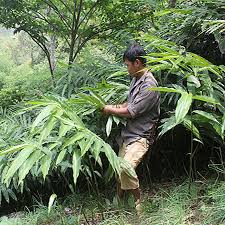
With its adaptability to natural forest canopies, strong regeneration ability, fast growth and dispersal, high economic value, and good market demand, Purple Amomum has become an effective “poverty alleviation tree” in highland, sloping, and arid areas.
1. Planting Season
- Spring Crop: February – March. The spring season has drizzling rain, moist soil, and less sunlight, which helps seedlings recover quickly.
- Autumn Crop: July – August. This period has heavy rainfall but also strong sunlight, requiring careful irrigation management.
- Winter Crop: November – December. Although there is little rainfall and dry soil, with sufficient irrigation, the plants can still achieve good results.

2. Planting Methods and Density
Planting Under Planted Forest Canopy
- Intercropping with main tree species such as Acacia, Manglietia, and Neem to utilize canopy cover for Amomum growth.
- Clearing vegetation: Remove weeds and vines. If the canopy cover is over 0.7, it should be pruned to 0.5 – 0.6.
- Planting arrangement: Dig holes along the rows of the main trees, maintaining a 1m distance from their base.
- Planting density: 6,000 – 9,000 plants/ha, with a spacing of 1m x 1m per plant.
- Post-planting care: Maintain canopy coverage at below 0.6.

Planting Under Natural Forest Canopy
- Clearing vegetation: Remove unnecessary shade trees while preserving valuable timber and non-timber forest products.
- Planting method: Depending on conditions, Amomum can be planted in strips or clusters. In natural forests, it is common to plant in clusters due to valuable existing tree cover.
- Hole spacing: 1 plant per 1m², keeping 2 – 4m away from the main trees.
- Post-planting care: Maintain canopy coverage at below 0.6.
Planting Under Fruit Tree Canopy or Mixed Gardens
- Clearing vegetation: Remove unproductive trees and prune fruit trees if possible.
- Planting arrangement: Amomum can be planted between fruit tree rows, keeping a 1m distance from the tree bases.
- Planting density: 6,000 – 9,000 plants/ha, with a spacing of 1m x 1m per plant.
Planting on Abandoned Swidden Land
- Site condition: Previously forested land, later used for tea or annual crops, but abandoned due to soil erosion and poor productivity. Slopes should be below 30°.
- Clearing vegetation: Remove most shrubs and small trees while keeping a few trees with light foliage (10 – 20% shade, max 30%) to prevent wind damage. Remove tree stumps, collect and burn weeds for ash.
- Planting density: 9,500 – 9,800 plants/ha, with a spacing of 1m x 1m per plant.


Note:
It is recommended to divide the plantation into 1,000m² plots and design pathways for easy access to transport seedlings, fertilizers, and facilitate maintenance.
3. Land Preparation, Fertilization, and Planting
- Land Preparation: Till the entire area to expose the soil, eliminate insect eggs, and kill weeds.
- Hole Digging: Holes should be 30 x 20 x 30 cm.
- Base Fertilization: Apply 1.5 – 2kg of decomposed manure per hole, mix with soil, and cover with a thin soil layer.
- Planting: Re-dig fertilized holes, break the soil finely, and mix it with fertilizer.
- If planting seedlings in nursery bags, cut the bag with a sharp knife before planting.
- Place the seedling upright, plant one sprout or one seedling per hole, cover with 6-10 cm of soil, and firmly press the base.
- Water thoroughly immediately if planting in sunny conditions to prevent dehydration and help root establishment.
4. Post-Planting Care
Watering
- Purple Amomum is moisture-loving, requiring proper irrigation, especially during early growth stages.
- If there is no rain after planting, water immediately. In the first 2-3 months, keep the soil consistently moist to ensure survival and sprouting.
- Once shoots emerge and develop into small clusters, watering can be reduced. However, in prolonged dry spells, irrigation is necessary.
- Watering method:
- Initially, water directly at the base.
- Later, use a sprinkler to cover the entire plant.
Replanting Gaps
- Some plants may die due to seedling quality or uneven care.
- When gaps are detected, replace them with reserved seedlings or split shoots from healthy clusters.
- Newly replanted seedlings require extra care to recover quickly.
Weeding and Fertilization
- Weeding:
- Use a hoe to remove weeds but manually pull weeds near Amomum plants to avoid damaging the shallow-rooted system.
- Allow removed weeds to dry in the sun to decompose and enrich the soil.
- In the first 1.5 – 2 years, weed every 2-3 months; in the first 6 months, weed every 1 – 1.5 months.
- Once Amomum forms dense clusters and covers the ground, weeds naturally decrease.
- Fertilization:
- Year 1: Apply 1 ton/ha of NPK-S 10:5.3:13 in June – July after weeding.
- Year 2 & 3: Apply 1 ton/ha of NPK + 1 ton/ha of organic fertilizer in March before flowering.
- Spread fertilizer evenly around the base. If Amomum forms a dense carpet, distribute fertilizer over the entire area.
Garden Maintenance
- Annually, prune and thin the canopy of shade trees to maintain 30% shade (not exceeding 70%).
- Since each Amomum shoot only lives for 2 years, remove yellowing or withering shoots to encourage flowering and fruiting.
- Also, remove excessive leaf litter at the base if it is too thick.
- This should be done in February – March before the first flowering season.
Protection Measures
- Amomum leaves are commonly eaten by cattle (buffalo, cows, goats).
- Fruits are often targeted by turtles, squirrels, porcupines, and rodents.
- Fencing is necessary: Use barbed wire with concrete poles, or bamboo/log fences. Living fences with rattan (Calamus) are the most durable option.
5. Pest and Disease Control
- Currently, no significant pests or diseases have been recorded in cultivated Purple Amomum.
- However, young plants (3 – 6 months old) may be attacked by small ladybugs that eat young leaf tissue and small caterpillars (Prodenia sp.) that roll leaves.
- Regular monitoring is essential to detect and control pest outbreaks early.
This guide ensures optimal growth and high productivity for Purple Amomum, supporting sustainable agriculture and economic development in mountainous and arid regions.