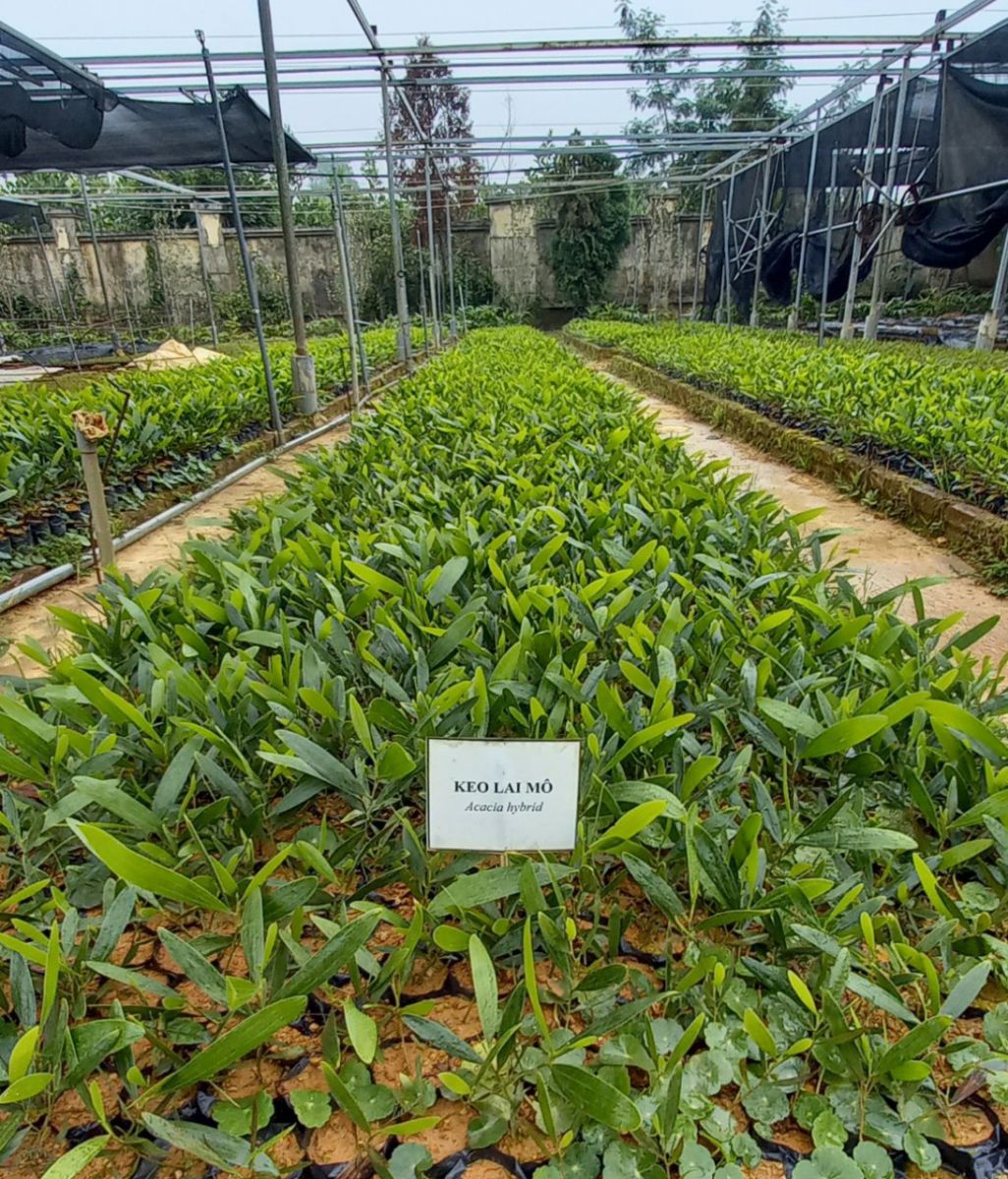
Tissue-cultured seedlings are produced on a large scale, yielding high productivity, excellent quality, and preserving the valuable genetic traits of the original variety.
Introduction to Intensive Cultivation Techniques for Tissue-Cultured Hybrid Acacia Plantations
Tissue culture technology is an indispensable link in the high-yield plantation industry as it is an effective tool that enhances the efficiency of commercial forestry. Tissue-cultured seedlings are produced on a large scale, ensuring high productivity, superior quality, and the retention of valuable genetic characteristics from the parent trees.

1. Land Preparation
For intensive hybrid acacia plantations using tissue-cultured seedlings, the land is fully cleared at the plot level, with tree stumps cut no higher than 10 cm. Before digging planting holes, all vegetation must be cleared and removed from the planting area. The planting holes should be evenly spaced, with trees arranged in a staggered pattern in adjacent rows, running parallel to contour lines.
2. Planting Density Arrangement
The recommended planting density for intensive tissue-cultured hybrid acacia plantations is 2,000 trees per hectare, with a spacing of 2 meters between trees and 2.5 meters between rows.
3. Soil Preparation and Fertilization
A 1m² area is loosened, and planting holes measuring 30 x 30 x 30 cm are dug in the center. The topsoil and subsoil should be separated during excavation.
Fertilization process:
- The planting hole is left open for 10–15 days before filling.
- Rocks, roots, and weeds must be removed.
- The topsoil is placed back first, mixed with fertilizer, followed by the subsoil.
- The hole is filled to form a small mound.
Fertilizer application:
- 0.2 kg of NPK per hole as a basal fertilizer.
- 0.2 kg of NPK per tree as an annual booster fertilizer in the second year.
4. Plantation Establishment
4.1. Planting Season
Planting should be carried out from September 15 to December 31, avoiding extremely hot or rainy days.
4.2. Planting Method
A monoculture system is used for hybrid acacia plantations.
4.3. Seedling Preparation
Seedlings are grown in primary PE nursery bags.
5. Seedling Quality Standards

Seedlings must have a clear origin and provenance, be produced via tissue culture, and show vigorous growth with no deformities, pests, or broken tips.
- Nursery period: At least 3 months.
- Height (Hvn): 25–30 cm.
- Root collar diameter: 0.25–0.3 cm.
6. Seedling Transport and Planting
6.1. Seedling Transport
When transporting seedlings from the nursery, they must be handled with care to prevent mechanical damage. Transport should be done on cool, cloudy days to avoid excessive stress and physical damage.
6.2. Planting Process
- A hole is made at the center of the planting spot, slightly deeper than the seedling’s root ball.
- The plastic nursery bag is carefully removed using a knife.
- The seedling is placed upright in the hole.
- Fine soil is added and gently compacted around the root ball.
- A mound is formed around the base, 2–3 cm higher than the root collar.
- After 10–15 days, any tilted, uprooted, or dead trees must be adjusted or replaced.
7. Maintenance and Protection
7.1. Maintenance Schedule
Tissue-cultured hybrid acacia plantations require 3 years of continuous care, with 2 maintenance sessions per year in the first two years, and 1 session in the third year.
First Year:
- Session 1 (April–June): Clear vegetation, remove climbing vines, weed, and mound soil around the tree base.
- Session 2 (September–December): Repeat the above steps, plus replant missing trees to maintain initial planting density.
- Fertilization: Two 20 cm deep, 30 cm long trenches are dug 25 cm away from the tree base for 200g of NPK, which is mixed with soil and covered.
Second Year:
- Session 1 (April–June): Repeat first-year maintenance steps.
- Session 2 (September–December): Dig two new trenches, 35 cm from the tree base, alternating positions with the previous trenches for fertilization.
Third Year:
- One maintenance session (September–December), repeating previous maintenance steps.
7.2. Thinning and Forest Stand Management

Hybrid acacia plantations require thinning once the canopy closes, 3–5 years before harvest. Thinning is essential to maintain optimal growth conditions.
Objectives of Thinning:
- Adjust tree density at different growth stages for maximum productivity and commercial value.
- Remove weak, diseased, or suppressed trees.
- Shorten the rotation period without significantly affecting final yield.
- Utilize intermediate products while ensuring sustainable land use.
Thinning Principles:
- Retained trees should be healthy, well-shaped, with a balanced crown and no major defects.
- Removed trees include poorly formed, diseased, damaged, or low-value trees.
Thinning Execution:
- The best season for thinning is before the main growing season.
- Thinning frequency:
- 1–3 times for timber production.
- 1–2 times for pulpwood production.
- Spacing strategy:
- Strong thinning: Spacing equals the mature crown diameter.
- Moderate thinning: Spacing equals 1/2 of the mature crown diameter.
- Light thinning: Spacing equals 1/3 of the mature crown diameter.
Implementation Guidelines:
- Within rows: One tree is retained, followed by one tree removed.
- Between rows: Thinned trees should be staggered in a zigzag pattern.
- Execution timing: Before the growing season.
- Thinning must not damage retained trees.
- Second thinning requires ropes to control falling branches and trunks.
Thinning Regulations:
- Light-demanding, fast-growing species with a straight trunk require early and strong thinning.
- Strict prohibition against using thinning as an excuse for excessive harvesting.
- Thinning operations must be supervised and documented.
- A control plot (0.5–1.0 ha) should be left untouched for monitoring.
7.3. Plantation Management and Protection
Pest and Disease Control
- Regular forest patrols must be conducted to detect pests or diseases early.
- If pests spread widely, professional forestry authorities must be notified.
Fire Prevention and Other Threats
- Fire prevention is critical during dry seasons; firebreaks must be established.
- Livestock grazing in young plantations is strictly prohibited.
- Illegal logging and tree damage are forbidden.
- Regular patrols should be conducted to detect and prevent unauthorized activities.
- Coordination with local authorities and forest rangers is essential for law enforcement.
By implementing these intensive cultivation techniques, hybrid acacia plantations can achieve high productivity, excellent wood quality, and sustainable forestry development.