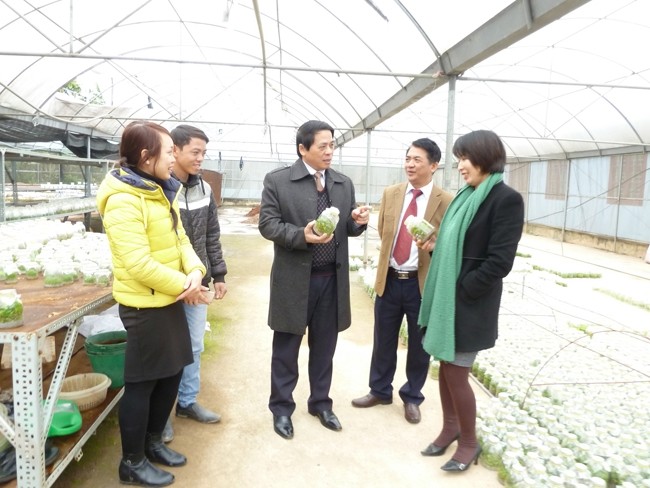

Leaders of Thai Nguyen University Conduct a Survey and Research at the Institute of Forestry Research and Development, Thai Nguyen University of Agriculture and Forestry
Bringing the Party’s resolutions to life in a practical and effective manner requires feasible measures. The Party Committee of Thai Nguyen University has focused its intellect on concretizing the resolutions of Party congresses at all levels into specific projects and programs. These initiatives are then led and implemented within every Party organization and among Party members, creating new development strides.
Keeping Up with Market Trends
Thai Nguyen University is making groundbreaking moves to become a high-quality regional university. During our visit to some training and research facilities at the Thai Nguyen University of Agriculture and Forestry, a member of Thai Nguyen University, we witnessed this transformation firsthand.
The Northeast Fisheries Training, Research, and Development Center, spanning 3.2 hectares, provides high-value aquatic breeds to six northern mountainous provinces: Cao Bang, Ha Giang, Lang Son, Bac Kan, Thai Nguyen, and Yen Bai. This center serves as both an educational model for students and a commercial fisheries enterprise while preserving valuable fish species such as spiny softshell turtles, Hemibagrus, Semilabeo notabilis, and red-eye barbs. By raising commercial fish and producing fingerlings, the center generates revenue for the university.
In recent years, the university has focused on investing in modern equipment to gradually build a strong reputation in professional practice training. The Institute of Life Sciences, in addition to research and technology transfer in biotechnology, pharmaceuticals, biomedical technology, food processing, and environmental technology, has invested in advanced machinery, commercialized its services, and achieved financial autonomy.
A prime example of a successful technology enterprise is the Institute of Forestry Research and Development, under the leadership of Associate Professor Dr. Tran Thi Thu Ha. She is recognized by her colleagues as a passionate scientist with strong management skills. When we visited the institute at nearly noon, we observed a serious work atmosphere, with staff having lunch on-site to maximize productivity. The institute’s modern research facilities cater to orders from 50 provinces and cities nationwide.
The institute’s flagship products include region-specific plant varieties, with acacia and eucalyptus seedlings being the most in-demand. Additionally, it cultivates medicinal plants such as Anoectochilus (a rare herbal plant) and Bac Kan ginger, which commands a market price of 1 to 1.5 million VND per kilogram. Thanks to its strong scientific research capabilities and market adaptability, the institute has maintained complete financial autonomy for years.
Accompanying us on the visit, Associate Professor Dr. Nguyen Ngoc Nong, Deputy Secretary of the Party Committee and Vice Rector of Thai Nguyen University of Agriculture and Forestry, outlined the university’s leadership and development goals:
“The university must establish strong ties with localities and businesses to enhance training quality, increase labor utilization, and develop strategic training objectives. The Party Committee is implementing the ‘Enterprise and Employer Connection Project’ to objectively and accurately assess training quality.”
In 2015, the university generated over 40 billion VND and millions of U.S. dollars through research and technology transfer. Based on these achievements and future needs, state agencies should establish staffing quotas and recruit professionals in ornamental horticulture, post-harvest technology, and aquaculture—fields that are essential to society. Additionally, a dedicated state agency is needed to forecast labor demand, plan workforce training, and assess surplus labor, providing universities and colleges with a foundation for training needs.
Creating a Channel to Implement Party Resolutions
Thai Nguyen University comprises 24 member units, including seven universities, one college, two affiliated faculties, five research institutes, and multiple research centers and training service units. With nearly 100,000 faculty members and students, it plays a crucial role as a training center for human resources in Vietnam’s northern midland and mountainous regions.
The university’s Party Committee operates as a higher-level Party organization under the Thai Nguyen Provincial Party Committee, with more than 3,700 Party members in 11 affiliated Party cells and committees. During the 2010–2015 term, the Party Committee translated its full-term work program into 11 strategic projects covering academic affairs, Party development, infrastructure, and management. Each project was supported by well-defined resources, funding, and implementation timelines. Some projects focused on improving training quality, such as assessing graduate employment outcomes and evaluating students’ proficiency in foreign languages, IT, and professional skills.
For four consecutive years, the university has invited employers and labor market experts to assess graduates’ performance, allowing it to adjust training programs to align more closely with real-world demands. As a result, Thai Nguyen University’s graduates are well-regarded in the job market, leading several provinces in the Northwest region to collaborate with the university on localized workforce training.
With increasing demand for personnel in new rural development initiatives, some localities, such as Van Chan District in Yen Bai Province, have requested university instructors to provide direct training for commune-level leaders and managers. On average, the university admits 600 new Party members annually, over 70% of whom are students. Graduates of the university are actively contributing to Vietnam’s political system at all levels, supporting new rural development efforts, especially in ethnic minority and mountainous areas.
Implementing Party resolutions effectively to drive rapid and synchronized development has been a key concern of the university’s leadership across generations. Regarding this matter, Professor Dr. Dang Kim Vui, Secretary of the Party Committee and Director of Thai Nguyen University, explained:
“The action program for implementing the Party Congress Resolution at Thai Nguyen University for the 2015–2020 term includes nine projects on Party-building efforts. Every six months, the Party Committee organizes inspection teams to review progress, identify challenges, and propose solutions. Each Party member, faculty member, and staff member is required to create a personal action plan for professional development. Based on individual training needs, the university develops a comprehensive training strategy and policies to support Ph.D. and master’s training domestically and abroad. Moving forward, the university aims to maintain stable enrollment in formal education, reduce non-formal training, and focus on improving training quality. We will enhance the accreditation of 150 existing programs and set a target of having 10 to 15 programs independently accredited by international organizations by 2020.”
The innovative approaches used by Thai Nguyen University in implementing Party resolutions serve as valuable references for other educational institutions and research organizations. Party resolutions remain effective and relevant when they directly address people’s rights, obligations, and urgent societal needs.
For those interested, more information is available on the Nhan Dan Newspaper website at:
http://www.nhandan.com.vn/chinhtri/tin-tuc-su-kien/item/28991502-buoc-dot-pha-o-dai-hoc-thai-nguyen.html
(Source: Nhan Dan Newspaper)