Scientific name: Disporopsis longifolia Craib
Family: Convallariaceae (Acharya et al., 2009)
Botanical Description
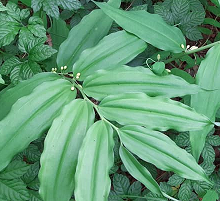
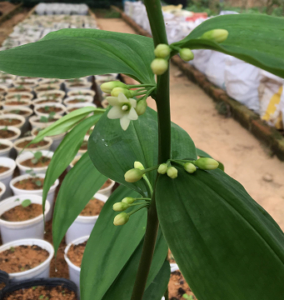
White Polygonatum is a perennial herb. It has thick, segmented, creeping rhizomes with prominent nodes and scars from withered aerial stems. The aerial stem is erect, smooth, and reaches 0.6–1 m in height. Leaves are sessile, alternate, lanceolate to ovate-lanceolate, 10–20 (up to 27) cm long and 2.6–6 (up to 10) cm wide. Leaf tips are acute, and blades are glabrous.
Flowers are white and bell-shaped, arranged in clusters of 6–7 hanging flowers borne in the leaf axils. Each flower is about 1 cm long. The perianth is tubular with 6 lobes. There are 6 stamens inserted at the throat of the tube, with flat filaments bearing two appendages at the apex.
The mature fruit is a soft, spherical berry that turns purplish-black upon ripening.
-
Flowering period: March–June
-
Fruiting period: June–August
-
Reproduction is by rhizomes or seeds (Đỗ Tất Lợi, 2004).
Ecological Distribution
White Polygonatum thrives in moist, shady environments with cool, humid climates throughout the year. It commonly grows in clumps in humus-rich moist soil, on rocky crevices, along stream corridors, and under the canopy of humid forests at elevations of 400–1,600 m (Thomas, 2006).
In Vietnam, it is found in high mountainous provinces such as Hòa Bình, Hà Tây, Ninh Bình, Lai Châu, Điện Biên, Lào Cai, Sơn La, Hà Giang, Yên Bái, Cao Bằng, and Nghệ An.
Medicinal Value
Modern biochemical studies show that Hoàng tinh contains glucose, mannose, galacturonic acid, and fructose (Pengelly, 2004).
According to traditional Taiwanese medicine, once processed, the rhizome enhances immune function, helps prevent atherosclerosis, lowers blood sugar levels, improves coronary blood flow, and possesses anti-inflammatory properties (Pengelly, 2004).
Propagation and Nursery Techniques
White Polygonatum can be propagated via rhizome division, whole rhizome planting, or tissue culture.
Planting Season
Planting is recommended in two seasons:
-
Spring–summer crop: March
-
Autumn–winter crop: September
Soil Preparation and Land Management
-
Land preparation: Dig the entire plot or create planting strips or clusters. The soil must be loosened.
-
Planting hole dimensions: 30 x 30 x 30 cm
-
Spacing: 1 x 1 m
-
Density: 10,000 plants/ha
-
Fill planting holes at least 15 days before transplanting, incorporating organic or bio-fertilizer.
Fertilization
-
Basal fertilization:
-
Apply 1 kg of well-rotted manure and 0.1 kg of bio-organic fertilizer per hole.
-
Mix the fertilizers evenly and cover with a thin soil layer to avoid root burn.
-
-
Top dressing:
-
Use well-composted manure combined with bio-organic fertilizer.
-
Apply 3 months after planting, ~20 cm away from the base, ideally after rainfall.
-
Planting and Maintenance
-
Planting method: Can be planted in concentrated plots or scattered under natural forest canopy, planted forest canopy (with >30% coverage), or intercropped with fruit trees.
-
Planting technique: Use a small hoe to dig a hole to the depth of the seedling root ball. Remove the pot, position the seedling upright, press soil around the root ball, and allow the rhizome to protrude slightly above the soil surface. Level with the top of the root ball.
-
Maintenance:
-
Weed regularly, remove fallen branches and leaves covering young plants.
-
Loosen soil around clumps after 3 months of planting. Avoid damaging roots or shoots.
-
Pest and Disease Control
Frequently monitor the nursery and propagation areas to detect and remove pests or diseased plants promptly.
Harvesting and Post-Harvest Handling
-
Harvest season: Typically harvested after 3 years, in spring or autumn.
-
Harvest method: Clear aboveground parts, then carefully dig up the rhizomes to avoid breaking or damaging them.
Harvesting tools and supplies: hoes, baskets, plastic bags, sacks, plastic sheets for drying, transportation carts, tying ropes, and product labels. All tools and materials must be clean, rust-free, and uncontaminated.
-
Transportation:
-
All vehicles used must be cleaned before use.
-
Do not use vehicles previously used for fertilizers, pesticides, livestock, chemicals, soil, or other contaminants.
-
Avoid trampling, overpacking, or mixing with other products during loading.
-
Unload immediately to avoid deterioration due to heat build-up.
-
Processing
-
Cleaning: Remove small roots, wash off soil and sand, and let air dry.
-
Drying:
-
Sun-dry on bamboo trays or directly in mild sunlight for 4–5 days.
-
Alternatively, oven-dry at 50–60°C for 26–30 hours until fully dried.
-
-
Powdering: Dried rhizomes may be ground into powder if required.
Packaging and Storage
-
Packaging: After drying and cooling for 20–30 minutes, immediately pack. Use two-layer packaging: an inner plastic bag and an outer jute sack; or a single new sack tightly sealed.
-
Labeling: Each bag must be labeled with the following:
-
Name of medicinal material: White Polygonatum (Disporopsis longifolia Craib)
-
Net weight
-
Harvest location
-
Collector’s name (household representative)
-
Address (village, commune, district, province) / phone (if available)
-
Date of harvest / processing and packaging (day/month)
-