Scientific name: Lonicera japonica Thunb.
Family: Caprifoliaceae
Botanical Characteristics
Japanese Honeysuckle is a climbing vine that can grow up to 10 meters or more. Young stems are light green and covered with fine hairs; as they mature, they turn reddish-brown and become smooth.
Leaves are opposite, sometimes arranged in whorls of three, ovate-lanceolate in shape with slightly blunt tips and rounded bases. Petioles are short (2–3 mm), and both surfaces of the leaf are finely pubescent.
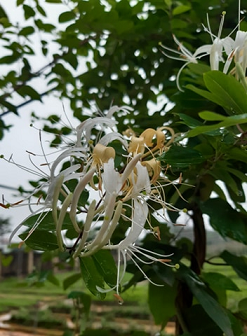
From May to August, flowers grow in pairs at the leaf axils, with each axil bearing a stalk carrying two flowers, thus each pair of opposite leaves supports four flowers. The fruit is an elongated ovoid, about 5 mm in length.
Chemical Composition and Medicinal Properties
The plant contains various active compounds including tannins, inositol, luteolin, β-sitosterol-D-glucoside, isochlorogenic acid, β-sitosterol, stigmasterol, stimasteryl-D-glucoside, chlorogenic acid, and ginnol.
Honeysuckle flowers contain flavonoids such as scolymoside and lonicerin, and several carotenoids (S-carotene, cryptoxanthin, and auroxanthin). In traditional Chinese medicine, honeysuckle has been used as an antipyretic, digestive aid, and treatment for dysentery.
Dried flowers are used as a diuretic. Honeysuckle also improves lipid metabolism in hyperlipidemia; ester concentrations in blood serum decrease after treatment. Distilled flower bud extract (Flos Lonicerae) is used as an injectable remedy for bacterial infections (Thomas, 2006; Shang et al., 2011).
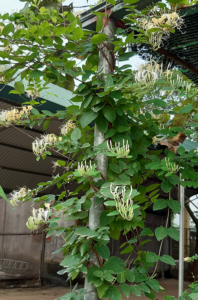
Morphology of Honeysuckle
Propagation and Nursery Techniques
Japanese Honeysuckle can be propagated asexually by stem cuttings or via tissue culture.
Seedling Standards:
-
From stem cuttings:
-
Seedling height: 15–20 cm with 5–6 leaves
-
Vigorous growth, healthy root system, pest- and disease-free
-
Seedling age: 3 months (from propagation to nursery release)
-
-
From tissue culture:
-
Height: 10–15 cm with 5–6 leaves
-
Vigorous growth, healthy roots, lush green leaves, free of pathogens
-
Age: 3 months from transplantation into pots to field readiness
-
Planting Season
The optimal time for planting honeysuckle is from February to March.
Land Preparation and Planting Technique
-
Planting method: Can be cultivated either in concentrated plantations or scattered under natural or planted forest canopy.
-
Vegetation clearance: Remove all vines and shrubs; retain only upper canopy trees.
-
Soil preparation: Thorough digging and loosening of soil.
-
Planting hole size: 30 x 30 x 30 cm.
-
Spacing: 1.0 x 1.5 m (approx. 6,666 plants/ha).
-
Support structure: Install three bamboo or wooden stakes (2 m long, 5–6 cm in diameter) per plant in an X shape for climbing.
Fertilization
-
Basal application: 0.5 kg of well-decomposed manure and 0.05 kg of organic biofertilizer per hole.
-
Top dressing: Twice annually (March–April and November–December), applying 0.1 kg of organic biofertilizer per hole each time.
Planting and Maintenance
-
Planting method: Dig a hole in the center of the pit equal to the length of the seedling’s root ball. Remove the potting bag, place the seedling upright, gently press surrounding soil, and cover to the base level.
-
Weeding and soil loosening: Weed regularly, especially during rainy seasons. Perform 2–3 soil loosening and mounding operations annually to aerate the root zone.
-
Watering: Maintain adequate moisture for growth; water regularly. The plant typically sprouts after one month.
Watering technique: Either water directly at the base or use furrow irrigation, allowing water to rise to bed level then stop, which helps retain moisture longer. Use only clean, uncontaminated water. Drain immediately in case of waterlogging.
Pest and Disease Management
Monitor regularly and remove pests manually, as honeysuckle is generally resistant to insect damage. Avoid using pesticides to maintain the medicinal quality of the plant.
Harvest and Post-Harvest Handling
-
Harvest season: Late May to early June, depending on climate. Flowering occurs over ~15 days. The ideal time is when buds turn from green to white and begin to open. Harvesting too early or too late reduces yield and quality.
-
Harvest time of day: Best before 9:00 a.m. for whiter dried flowers. Harvested after 10:00 a.m. may result in yellowing.
-
Flower harvesting: Use scissors to cut flower-bearing branches; remove flowers and chop stems into 2–3 cm sections.
Vine harvest: First harvest ~50–60 days after planting, then every 6 months. Cut stems ~30 cm from the ground, chop into 3–4 cm pieces, and sun- or oven-dry to <12% moisture.
Flower harvest: Focused in late May to early June (in Northern Vietnam), ideally when buds begin to open. Harvest in early morning or late afternoon. Dry at 20–25°C immediately after harvest.
Tools and supplies: Scissors, harvesting knives, baskets, transport carts, tarps, plastic bags, sacks, ropes, and labels. All tools must be clean, rust-free, and uncontaminated.
Transportation: Clean vehicles before transporting honeysuckle. Do not use vehicles that carry fertilizers, pesticides, livestock, chemicals, or potential contaminants. Do not step on or tightly compress materials during loading. Unload immediately upon arrival for fresh materials to avoid spoilage from heat.
Processing
Immediately after harvest, flowers must be dried—this is the most technically critical step. Poor drying affects quality significantly. There are two main methods:
-
Sun-drying: Flowers are dried on flat bamboo trays. Initial drying may not be complete in one day and requires additional drying after three days.
-
Oven-drying: Optimal drying method. Use specialized dryers (e.g., 4.2 m long with 6 shelves, 40–50 cm apart, drying 12 kg per shelf, total 72 kg per batch). Ensure proper ventilation, temperature between 38–42°C. Overheating can cause brittleness and color changes. After drying, flowers may be briefly sun-dried for improved appearance.
Packaging and Storage
-
Packaging: After drying and cooling for 20–30 minutes, pack immediately. Use double-layered packaging: an inner plastic bag and an outer sack. Alternatively, use a new single-layer sack sealed tightly.
-
Labeling: Each package must include:
-
Product name: Honeysuckle flower (Lonicera japonica Thunb.)
-
Net weight
-
Harvest location
-
Collector’s name (household representative)
-
Address (village, commune, district, province) and phone number (if available)
-
Harvest/processing and packaging date
-
-
Storage: Honeysuckle is moisture-sensitive and prone to mold and discoloration. Store in a dry, cool place in sealed jars or bags with lime lining to absorb moisture.
-
Avoid contact with fertilizers, pesticides, and chemicals.
-
Do not overstack bags.
-
Keep away from animals and livestock.
-
Do not use rodenticides or termiticides in storage.
-
Conduct regular inspections for pests or spoilage.
-
Contact herbal dealers immediately after labeling and packaging for procurement.
-
Record-Keeping and Traceability
Maintain detailed logs of planting, care, harvesting, and daily processing. Attach labels or inventory tags to each package for full traceability.