Scientific name: Zingiber purpureum Roscoe
Family: Zingiberaceae
Botanical Description
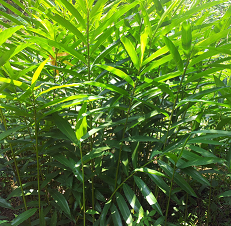
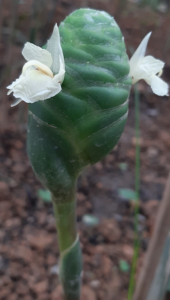
Mountain Rock Ginger is a perennial herbaceous plant reaching over 100 cm in height. The cross-section of the stem near the base is round. Leaves are narrowly ovate, 10–15 cm in length and 2.5–3.5 cm in width, with petioles shorter than 5 cm. Leaf margins are ciliate. The leaf blade has longitudinal stripes and is dark green with a strong aroma. The leaf margins are also dark green. The plant flowers once a year, with each clump bearing 3–5 flowers. Inflorescences are spike-like clusters; flowers are reddish-brown or yellow.
The rhizome is branched, small in size (<200 g), with reddish-brown skin. The inner flesh is greyish at the core with a yellow tinge around the periphery. Average yield is 2–3 kg of rhizomes per clump, with 8–10 daughter rhizomes. Rhizomes are 5–10 cm long and 2–3 cm wide at the widest point. The growth cycle is more than 10 months.
Ecological Requirements and Distribution
Mountain Rock Ginger typically grows on rocky mountains at altitudes of 500–1200 m above sea level. It thrives in humus-rich, loose soils in cool mountainous climates, prefers shade, and grows best under diffused light in primary forests. It is commonly found in valleys, rocky crevices, and under sparse forest canopies. In Vietnam, it is distributed in provinces such as Hà Giang, Cao Bằng, Bắc Kạn, and Lạng Sơn.
Uses and Medicinal Properties
The rhizomes of Zingiber purpureum have long been used by local people as a spice and preservative for specialty foods such as sausages, smoked meats, and salted pork. Medicinally, the rhizomes have anti-inflammatory and analgesic properties, and are used to relieve discomfort, dizziness, fainting, abdominal pain, and are believed to have anti-cancer potential (Đỗ Tất Lợi, 2001). Pharmacological studies have shown that essential oils from Mountain Rock Ginger are cytotoxic to cancer cell lines such as breast cancer (MCF-7), multidrug-resistant breast cancer (MCF7/ADR), adenocarcinoma (MDA-MB-231), and cervical cancer (HeLa), and exhibit antioxidant, antibacterial, and antifungal activities (Trần Công Luận et al., 2016).
Propagation and Nursery Techniques
Mountain Rock Ginger can be propagated by rhizome division or via tissue culture.
Seedling Standards:
-
From rhizome division:
-
Healthy green foliage
-
Height of 15–20 cm with 3 pairs of leaves
-
Vigorous growth, healthy root system, disease-free
-
3 months old (from propagation to transplant)
-
-
From tissue culture:
-
Height 10–15 cm with 3 pairs of leaves
-
Uniform growth, healthy roots, and lush green leaves
-
3 months old (from transplant into pots to field-ready)
-
Tissue-cultured seedlings offer genetic uniformity, maintain parent traits, and show high disease resistance, though they are more expensive than rhizome-divided seedlings.
Planting Season
The optimal planting time is from the first to the third lunar month, preferably during February when there is drizzle and high humidity.
Soil Preparation and Planting Technique
-
Soil Preparation: Clear weeds and debris; finely till the soil to ensure looseness and aeration.
-
Deep plowing (minimum 20 cm), remove residues, apply basal fertilizers and biological agents.
-
Prepare raised beds 10–20 cm high and 1–2 m wide, level the surface, and dig drainage ditches.
Planting Density and Spacing
-
Spacing: 50 cm x 40 cm
-
Density: 50,000 plants/ha
Fertilization
-
Basal application: 0.5 kg of well-rotted manure and 0.1 kg of NPK per hole, 15 days before planting.
-
Top dressing: Twice a year:
-
First application: March–April
-
Second application: November–December
-
Planting and Maintenance
-
Planting method: Can be cultivated in concentrated or scattered patterns under natural or planted forests with canopy cover of 30% or more, or intercropped under forest canopy.
-
Planting technique: After fertilizing the planting holes, place rhizomes 5–6 cm deep, avoiding direct contact with fertilizer. Cover with 4–5 cm of fine soil and gently press to ensure good contact. Level the soil surface.
-
Maintenance:
-
In forest understory or outdoors with shading nets.
-
Water sufficiently during dry spells. Reduce irrigation during disease outbreaks to limit spread.
-
Weed control and hilling: Hand weed or spray herbicides 25–30 days after planting, combined with first fertilizer application. Weed regularly and mulch the base to prevent rhizome exposure and preserve quality.
-
Protect cultivation areas from trampling or damage by animals.
-
Pest and Disease Management
Main pests and diseases on Mountain Rock Ginger include: cutworms, snails, leaf blight, rhizome rot caused by fungi and bacteria.
-
Cutworms:
Appear early in the rainy season.
Control: Use systemic insecticides like Basudin, Regent, Furadan.
Alternative: Use biological agents like garlic–soap–chili solution. -
Rhizome Rot Diseases:
-
Bacterial Soft Rot (Green Rot):
Caused by soil- and insect-borne bacteria. Plants suddenly wilt at midday but may recover in the evening, then die rapidly. Stems are water-soaked and darkened; pulling the plant reveals a foul-smelling, milky discharge.
Prevention: Apply Trichoderma mixed with composted organic fertilizer. -
Fusarium Wilt (Yellow Rot):
Caused by Fusarium spp., leads to yellowing leaves, slow dieback. Rhizomes show brown spots, shriveled and covered with white mycelium.
Control: Use Bima biological products or herbal pest control solutions (garlic–soap–chili mix).
-
Harvesting and Post-Harvest Handling
-
Harvest time: Depending on intended use, harvesting is done at the end of winter.
-
Harvesting method:
Carefully dig using hoes to avoid damaging the rhizomes. Uproot whole clumps, shake off soil, and separate rhizomes. -
Transportation:
Clean transport equipment before use.
Do not use vehicles that carry fertilizers, pesticides, animals, or contaminated materials.
Avoid stepping on, compacting, or mixing with other products during transport.
Unload immediately upon arrival to avoid heating and spoilage.
Processing
-
Cleaning: Wash off soil, drain thoroughly.
-
Drying:
-
Sun-dry on bamboo trays or directly under mild sun for 4–5 days.
-
Alternatively, dry in ovens at 50–60°C for 26–30 hours until completely dry.
-
Packaging and Storage
-
Packaging:
Cool for 20–30 minutes after drying before packing.
Use double-layer packaging: inner plastic bag and outer sack, or a single new sack, tied tightly. -
Labeling:
Include the following on each label:-
Herb name: Mountain Rock Ginger (Zingiber purpureum Roscoe)
-
Net weight
-
Harvest location
-
Collector’s name
-
Address and phone number (if applicable)
-
Harvest/processing date
-
-
Storage:
-
Store in cool warehouses, on shelves or platforms at least 50 cm above the floor and 10–20 cm from the wall.
-
Keep dry and ventilated.
-
Avoid storing near chemicals or fertilizers.
-
Do not overstack.
-
Keep isolated from livestock.
-
Do not use rodenticides or insecticides in storage areas.
-
Regularly inspect for potential damage.
-
Contact herbal dealers promptly after packing and labeling.
-
Record-Keeping and Traceability
-
Maintain detailed logs of cultivation, maintenance, harvesting, and daily processing.
-
Attach relevant information to packages via labels or warehouse tags for traceability.