1. Variety Description 
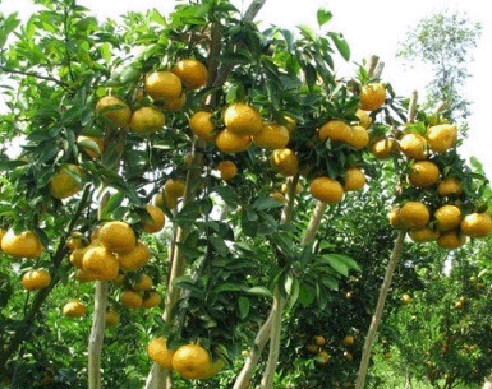
Bắc Kạn mandarins are distinguished from other mandarin varieties by their unique sensory and quality characteristics. They have a flattened round shape, smooth yellow skin, large juicy segments, golden-yellow pulp that is not mushy, a mildly sour and sweet taste, a soft texture, and a strong fragrance. The fruit is easy to peel.
2. Planting Techniques
Planting Season
In northern provinces, mandarins are best planted in spring and autumn. However, spring is the optimal season since spring rains help increase the survival rate of the plants.
Planting Holes & Fertilizer Application
-
Hole dimensions: 60x60x60 cm.
-
Base fertilization: Each hole should be prepared with:
-
15-20 kg of well-decomposed manure
-
0.5 kg of superphosphate
-
0.3 kg of potassium
-
0.2 kg of lime powder
-
The fertilizers should be mixed into the soil by digging small trenches around the plant canopy and covering them lightly with soil.
Planting Method
Dig a small hole in the middle of the mound, place the plant so that its root ball is level with the mound surface, and compact the soil around it. Cover the base with a 2-3 cm thick layer of straw. Water the plant immediately after planting with 2-3 scoops of water. Avoid watering if it is raining.
3. Care and Maintenance
Watering
-
Water 2-3 times after planting to help the roots establish.
-
In areas with irrigation systems, ensure watering during the sprouting phase and after fertilization.
Fertilization
-
Fertilization provides essential nutrients, including macronutrients (N, P, K, Ca) and micronutrients (Bo, Cu, Zn, Mn, Mg).
-
Each year, apply 30-40 kg of manure or organic fertilizer per tree, supplemented with chemical fertilizers.
Pruning Techniques
-
Formative pruning: Carried out within the first two years after planting. After planting or after a certain period, cut the main stem at a height of 70-80 cm. When new shoots emerge, retain 3-4 evenly distributed branches to form the main framework of the tree.
-
Maintenance pruning: Trim the tree for ventilation by removing dry branches, weak branches, diseased branches, broken branches, and sucker shoots from the grafted rootstock. This helps the leaves receive ample sunlight. Unlike some other fruit trees, mandarins do not require fruiting pruning.
4. Pest and Disease Control
-
Apply lime and fungal disease treatments to the tree trunk annually.
-
Avoid watering, fertilizing, or digging directly around the trunk.
-
Spray insecticides during new shoot growth and fruiting stages.
-
To limit soil-borne diseases affecting mandarin roots, apply Zineb at a rate of 40 kg/ha, divided into two applications in May and September (lunar calendar).
-
Early detection and removal of trees showing symptoms of greening disease are essential.
Common Pests and Diseases
-
Leafminer (Citrus Leafminer): Damages young trees and nursery plants. Use insecticides mixed with Cantect oil to spray thoroughly on leaf surfaces.
-
Stem and Branch Borers: Active from May to September. Detect and remove borers early by inserting a thin wire into their tunnels. After harvesting (November-December), apply lime to the tree trunk to kill eggs. Treat infested areas with fumigant pesticides such as Ofatox 400 EC (0.1%) or Supracide 40ND (0.2%).
-
Citrus Canker and Scab Disease: Primarily affects young trees and nursery plants. Symptoms include brown lesions on leaves, which may appear scattered or clustered. Spray with Bordeaux mixture (1-2%) or Kasuran (1/1000).
-
Gummosis (Phytophthora Citropthora): Common in poorly drained areas, affecting the lower trunk and roots. Spray Bordeaux mixture (1-2%) or apply Aliette or Benlate (2/1000) directly to infected areas and leaves.
-
Greening Disease (Huanglongbing – HLB): Symptoms include stunted growth, uneven canopy, and yellow-mottled leaves with green veins. Intercropping with guava at a ratio of 2 rows of mandarins to 1 row of guava helps limit the disease.
-
Tristeza Disease: Affects the tree base, causing overall yellowing of the leaves, similar to gummosis but without leaf deformation.
5. Harvesting
-
Harvest at the right time to maintain fruit quality. The ideal time is when 1/3 to 1/2 of the fruit skin has turned yellow.
-
Use pruning shears to cut the fruit from the tree to avoid damaging the skin or breaking branches.
-
Sort the fruit before storing or transporting to the market.