1. Description of the Variety
Name:
Mango (Mangifera indica L.) belongs to the Anacardiaceae family.
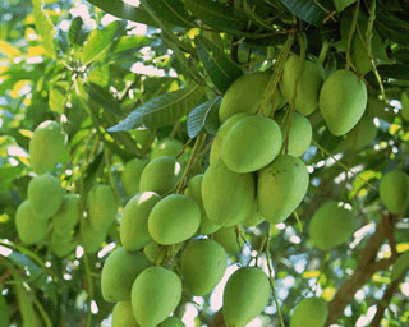
Thai mango grown in the nursery center is grafted and can bear fruit within two years after planting. Its yield and fruit quality are considered superior to many other mango varieties.
Morphological Characteristics:
-
Woody tree, 8–15 meters tall.
-
Compound leaves, small white flowers growing in large clusters.
-
Green drupe fruit, about the size of a duck egg; when ripe, the flesh turns pale yellow, crispy, slightly sour. The seed is large with many soft spines.
-
Fruit season: June – September.
Ecological Characteristics:
Mango can grow in various soil types, including yellow soil, red-yellow soil, ferralsol, old alluvial soil, new alluvial soil along rivers, and even sandy coastal soil. However, the best soil for cultivation is sandy or sandy-loam soil with good drainage, a soil depth of at least 1.5–2 meters, and a water table not shallower than 2.5 meters. Among fruit trees, mango is one of the most flood-tolerant species. Poorer, less fertile soils encourage more flowering and fruiting, whereas highly fertile soils with adequate moisture primarily support strong vegetative growth but fewer fruits.
2. Planting and Care Techniques
Planting Season:
Mango can be planted year-round, but the best time is at the beginning of the rainy season. However, for small-scale planting, various planting times are possible as long as extreme heat or cold is avoided, and adequate irrigation is provided after planting.
Planting Density:
Depending on soil fertility and tree structure, mango trees can be planted at a spacing of 7–9 meters (approximately 6.5–7 meters apart). In highland areas, wider spacing is preferable due to the tree’s longevity and large canopy. Generally, recommended spacing for mango orchards ranges from 9–15 meters.
Planting Techniques:
When digging planting holes:
-
Separate the topsoil and set it aside.
-
Apply 50 kg of well-decomposed manure and 1.5–2 kg of superphosphate per hole.
-
Mix the fertilizer with the topsoil and fill three-quarters of the hole.
-
Fill the rest with the lower soil layer to create favorable conditions for root development and improve soil fertility at the hole’s bottom.
Care Techniques:
Watering:
For young trees (1–3 years old), regular watering is essential to support continuous growth and canopy formation. In the initial stage after planting, water every 3–4 days. As the tree grows, reduce watering frequency but maintain consistent soil moisture around the roots. To retain soil moisture, apply mulch (dry grass, decomposed straw) around the base within a radius of 0.8–1 meter while leaving a 20 cm gap around the trunk to prevent pest infestations.
Weeding:
Regular weeding is necessary. Depending on the specific region, suitable weed control methods should be applied. Weeds can be dried and used as mulch around the base of the tree.
Fertilization:
Young Trees (Sapling Stage):
-
Annually apply 200–400 g of NPK 16-16-8 and about 200 g of urea per tree, divided into two applications at the beginning and end of the rainy season.
-
Additionally, apply 1–3 kg of KOMIX organic fertilizer for fruit trees to enhance soil organic matter and promote stable growth.
Mature Trees:
-
Apply 2–5 kg of NPK 16-16-8 and 3–4 kg of KOMIX per tree annually, divided into two applications: at the beginning of the rainy season and in September–October.
-
If the previous season had a high yield, increase fertilizer application to help the tree recover.
3. Pest and Disease Control
Anthracnose Disease:
-
Causes black rot in flowers, leading to flower drop, and black rot in fruits.
-
Use Benlat C or Score 250 EC, spraying weekly from flowering until two months after, then once a month.
Sooty Mold Disease:
-
Caused by secretions from aphids.
-
Control with Bassa 50 EC, Trebon 2.5 EC, or copper-based fungicides.
Leaf Blight Disease:
-
Develops during the rainy season, primarily affecting leaves.
-
Prevent by pruning infected leaves and spraying Rhidomil MZ 72 WP or Kasumin 2L.
Stem and Branch Borers:
-
Use light traps to capture adult insects.
-
Inject strong fumigants or systemic pesticides like Actara 25 WG or Padan 95 SP into boreholes, then seal with clay to kill larvae.
Green Leafhopper:
-
Affects mango growth by sucking sap, mainly active from October to June.
-
Control using Bassa 50 EC, Trebon 2.5 EC, etc.
Fruit Flies:
-
Attack fruit during the late ripening stage, laying eggs under the skin. The larvae feed on the flesh, causing rot and fruit drop.
-
Control with Sherpa 25 EC, Luc Son 0.26 DD, or Padan 95 SP.
4. Harvesting
Mangoes should be harvested when they reach physiological maturity, characterized by a bright pinkish skin color and the distinct ripening characteristics of the variety.
-
Harvest during cool, dry weather.
-
Classify the harvested fruits.
-
For long-distance transportation, pack fruits in baskets or boxes, ensuring no more than five layers per container, with straw or paper separating the layers.
-
After harvesting, clean the area around the tree, prune old and diseased branches, and continue post-harvest care.