
The Institute of Forestry Research and Development is a scientific and technological organization under the University of Agriculture and Forestry. It was established under Decision No. 87/QĐ-ĐHTN on January 16, 2015, by the Director of Thai Nguyen University, based on the transformation and upgrade of the Northern Mountainous Forestry Research Center.
The Institute has legal status, its own bank account, and seal, and operates autonomously in financial matters, following Government Decree No. 115/NĐ-CP.
The Institute has five main functions:
Conducting specialized scientific research, including applied sciences;
Transferring scientific and technological knowledge;
Supporting undergraduate and postgraduate training programs;
Participating in postgraduate education;
Engaging in international cooperation across all areas of the Institute’s activities.
Developing the Institute into a research center in forestry, natural resources, and the environment to serve research, scientific and technological transfer, and training under the University of Agriculture and Forestry – Thai Nguyen University.
Implementing scientific research and technology transfer activities in forestry, natural resources, and the environment, contributing to the advancement of science and technology in the region and supporting socio-economic development nationwide, particularly in mountainous provinces.
Agricultural and forestry plant breeding and afforestation;
Natural resource management;
Biotechnology in agriculture and forestry;
Environmental science;
Forest environmental services and climate change;
Information technology and remote sensing;
Economics and development;
Institutional policies;
Market processing and consumption of agricultural and forestry products.
Oversees all activities of the Institute of Forestry Research and Development.
Directly responsible for the following areas:
Administration and organizational affairs
Planning and finance
Scientific research and international cooperation
Inspection, legal affairs, and commendation
Responsible for the following areas:
Training, practical training, and internships for students
Business, consulting, and technology transfer
Union and cultural activities
The organizational structure of the Institute of Forestry Research and Development includes the Scientific Council, the Leadership Board, specialized departments, and the Experimental Station. The relationship between the Scientific Council, the Leadership Board, specialized departments, and the Experimental Station is outlined in the organizational chart.
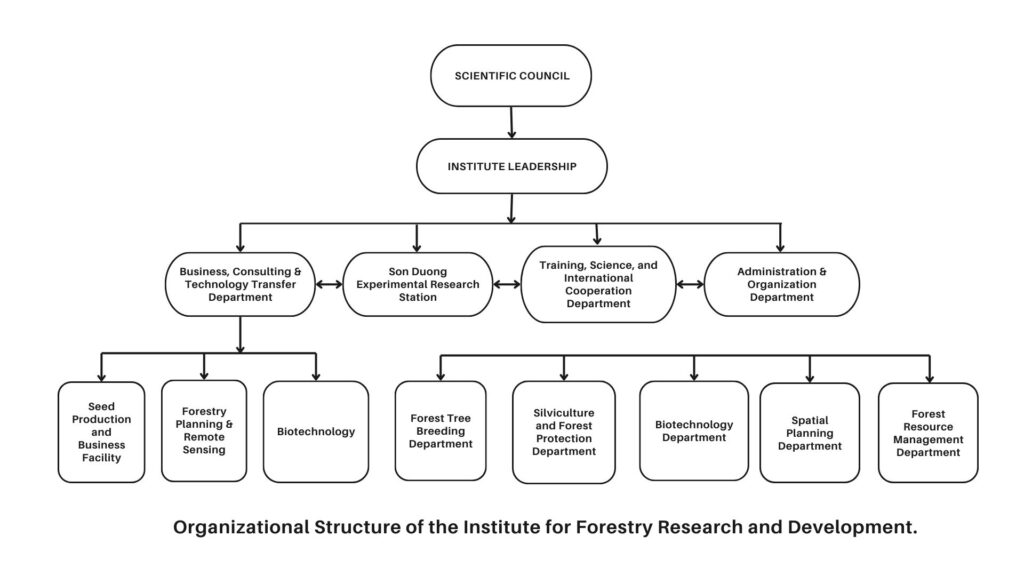
Functions and tasks: Advises the Institute’s leadership on developing medium- and long-term strategies, training, technology transfer, production, business, and consulting services in all fields of activity.
Structure: The Scientific Council consists of 18-20 experts, including professors, associate professors, and leading PhDs in various fields. The Council has specialized subcommittees in specific fields of activity.
Functions and tasks: Manages and directs all activities of the Institute; is responsible to the Party Committee, the University Board, and the Government for all assigned political and professional duties.
Administration and Organization Department
Functions and tasks: Assists the leadership in administrative work, document management, personnel management, commendation and reward, planning, and finance.
Training, Science, and International Cooperation Department
Functions and tasks: Assists the leadership in planning and implementing scientific research activities, managing research projects and technology programs, cooperating with domestic and international organizations, and organizing training and practical internship programs.
Sub-divisions: The department consists of five specialized divisions.
Functions and tasks of the divisions:
Conducting research and transferring scientific and technological knowledge.
Providing consulting services.
Coordinating training, workshops, and internships in collaboration with the university’s faculties.
Business, Consulting, and Technology Transfer Department
Functions and tasks: Assists the leadership in production, business, consulting services, scientific and technological transfer, and applying technological advancements to practical production.
Son Duong Experimental Station
Manages and implements research, technology transfer, and production activities on a 139-hectare site in Son Duong District and operates a nursery system in Tuyen Quang Province.