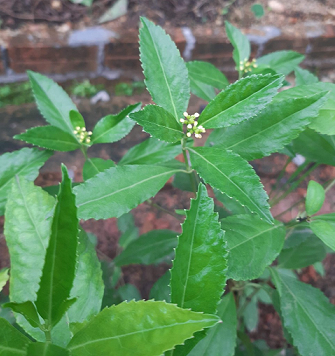
Scientific Name: Sarcandra glabra (Thunb.) Nakai
Family: Chloranthaceae
Characteristics
The Forest Wolf Plant is a small shrub, growing between 1-2 meters tall. It has a smooth stem with swollen nodes, and round, hairless branches. The leaves are opposite, lanceolate or ovate, 7-18 cm long, 2-7 cm wide, with 5-7 pairs of lateral veins. The petiole is short, about 5-8 mm, and the leaf margins have sharp serrations.
The flowering period starts in May and continues until November. The fruits begin to ripen at the end of August, with the ripening phase lasting until February of the following year. The plant bears compound inflorescences at the tip of branches, with short branches. The flowers are small, white, sessile, and have a single stamen. The ovary is oval-shaped and lacks a style. The fruit is small, nearly round (4×6 mm), juicy, and red-orange in color. The flowering season is from June to July, and the fruiting season is from August to September.
 |
 |
 |
Morphology of Sarcandra glabra (Forest Sarcandra)
Distribution
The Forest Wolf Plant thrives in areas with thick, loose, humus-rich soil, minimal rock content, high water retention, and good drainage. It requires sufficient moisture throughout its growth cycle.
This plant is found in several countries, including China, North Korea, Japan, India, Vietnam, and Malaysia. In Vietnam, it grows wild in limestone mountains, forest edges, and humid hillsides in regions such as Hà Giang, Cao Bằng, Lạng Sơn, Hòa Bình, Kon Tum, and Lâm Đồng.
Medicinal Uses
The Forest Wolf Plant contains three main compounds: Chloranoside A, tertorigenin 7-glucoside, and 1β; 3β-Dihydroxylup-20(29)-en, which are effective in treating bone and joint diseases such as rheumatism, joint pain, and digestive disorders. The leaf powder exhibits free radical scavenging activity in the DPPH system, making it applicable for treating inflammatory diseases and cancer.
In traditional medicine, the plant has a bitter, pungent taste and slightly warm properties. It helps promote blood circulation, relieve pain, expel wind-dampness, reduce inflammation, and detoxify the body.
-
Roots: Soaked in alcohol and consumed to alleviate chest pain.
-
Leaves: Used as a decoction for tuberculosis treatment, ground and applied for snake bites, or infused in alcohol for wound healing, skin ulcers, and joint pain.
Plant Morphology
Propagation Methods
The Forest Wolf Plant can be propagated using cuttings or tissue culture techniques.
Seedling Standards
-
Seedlings from Cuttings:
-
Height: 15-20 cm, with 5-6 leaves.
-
Well-developed root system, disease-free, with vibrant green leaves.
-
Age: 3 months (from sowing to nursery transfer).
-
-
Seedlings from Tissue Culture:
-
Height: 15-20 cm, with 5-6 leaves.
-
Strong, healthy, disease-free root system with lush green leaves.
-
Age: 3 months (from transplanting to nursery transfer).
-
Tissue culture seedlings are genetically uniform, resistant to pests, but more expensive than cuttings.
-
Planting Season
The best time to plant the Forest Wolf Plant is from March to April.
Soil Preparation and Land Preparation
-
The soil should be plowed, cleared of weeds (without using herbicides), and well-drained.
-
Deep tillage of 20-30 cm is recommended.
-
Base fertilization: Organic compost should be mixed with the soil before planting.
-
Raised beds should be 35-40 cm high and 120 cm wide to ensure proper drainage.
Spacing and Planting Density
-
Spacing: 1.0m × 1.0m.
-
Planting Density:
-
Normal soil: 10,000 plants/ha.
-
Fertile soil: 5,000 plants/ha.
-
Fertilization and Fertilizing Techniques
-
Base Fertilization (Before Planting)
-
5,000 kg of decomposed organic manure + 150 kg of organic microbial fertilizer.
-
Mix well and cover with a thin layer of soil to prevent root damage.
-
-
Top Dressing (Divided into 3 Applications)
-
1st application (2-3 months after planting): 100 kg organic microbial fertilizer.
-
2nd application (during peak growth in July-August): 5,000 kg organic manure + 150 kg organic microbial fertilizer.
-
3rd application (November-December): 100 kg organic microbial fertilizer.
-
Planting and Care Techniques
Planting Method
-
Dig planting holes in rows and apply base fertilizers.
-
Cover fertilizers with a thin layer of soil before planting to avoid direct root contact.
-
Place seedlings gently beside the fertilizer, cover the roots with soil, and press firmly around the base.
Care and Maintenance
-
Weeding: Regular weeding, especially during the rainy season and the early growth stage.
-
Watering:
-
Water immediately after planting.
-
For the first 30 days, water once a day to maintain 70-80% moisture.
-
Maintain soil moisture throughout the growth cycle.
-
Water after fertilization to help nutrient absorption.
-
Use clean surface water, free from pollution.
-
-
Drainage: The plant prefers moist conditions but cannot tolerate waterlogging. Raised beds help prevent root rot.
Replanting and Weed Control
-
Replant missing seedlings within the first 1-2 months to ensure uniform growth.
-
Weeding frequency: Once a month for the first two months, then gradually reducing frequency.
Pest and Disease Control
The Forest Wolf Plant is resilient, but regular monitoring is necessary to prevent infestations.
-
Regularly remove diseased or old leaves and destroy infected plant debris.
-
Use botanical pesticides for pest control.
-
Apply Integrated Pest Management (IPM) to minimize chemical use.
Harvesting and Storage
Harvest Time
-
The plant can be harvested after three years, during the summer-autumn season, on dry days.
Harvesting Technique
-
Required tools: knives, ropes, transport carts, tarpaulin, plastic bags, woven sacks, labels.
-
Ensure tools are clean and free from rust or contamination.
Transportation
-
Use clean vehicles that haven’t transported fertilizers, pesticides, livestock, or other contaminants.
-
Unload immediately upon arrival at the processing site to prevent spoilage.
Processing
-
Removing Impurities: Manually remove weeds, diseased leaves, and moldy parts.
-
Cleaning: Wash 2-3 times in clean water, then drain before drying.
-
Drying:
-
Sun-drying: Spread evenly on mats or tarpaulin, stir frequently.
-
Oven-drying: Use specialized herbal dryers at 35-40°C for 26-30 hours, reducing moisture content to below 13%.
-
Packaging and Storage
-
Packaging: Use double-layered bags (inner thick plastic, outer woven sack).
-
Labeling: Each package should have: herb name, weight, collection site, harvester, address, and processing date.
-
Storage Conditions:
-
Keep 50 cm above the ground and 20-30 cm away from walls.
-
Store in a dry, ventilated area away from pesticides and fertilizers.
-
Avoid using rodenticides or pesticides in storage.
-
Record-Keeping and Traceability
-
Maintain daily logs for planting, harvesting, and processing activities.
-
Attach labels or storage tags to each package for tracking.