Introduction
Kaempferia galanga, also known as “Thiền Liền” or “Sa Khương,” belongs to the Zingiberaceae family and is widely used in traditional medicine. According to Eastern medicine, Kaempferia galanga has a spicy taste and warm properties, with functions such as warming the spleen and stomach, relieving pain, promoting blood circulation, eliminating phlegm, dispelling cold, aiding digestion, and expelling toxins.
Kaempferia galanga is mainly distributed in Southeast Asia and China. Its rhizomes contain essential oils, which are widely used as spices, in beverages, and in the cosmetic industry. Extracts from the rhizomes contain ethyl-p-methoxycinnamate, ethyl cinnamate, 3-carene, camphene, borneol, cineol, kaempferol, and kaempferide, which have been reported to exhibit biological properties such as antibacterial, antimicrobial, anticancer effects, as well as pharmacological activities including vasorelaxation, anti-inflammatory, analgesic, and antipyretic properties. The medicinal and economic value of Kaempferia galanga has been recognized by both traditional and modern medicine, making it a highly valuable medicinal plant both globally and in Vietnam.
In Vitro Propagation Research
The Institute of Forestry and Sustainable Development at Thai Nguyen University of Agriculture and Forestry conducted an in vitro propagation study on Kaempferia galanga rhizome samples.
Preliminary results show:
-
Sterilization of sprout samples using 1% NaClO for 3 minutes, combined with 15% bleach (Javen) for 10 minutes and soaking in 10% Cefotaxime for 30 minutes, resulted in a 93.33% success rate of clean samples sprouting after 4 weeks when cultured in MS medium.
-
The optimal medium containing 1.5 mg/L BAP and 0.2 mg/L NAA achieved a shoot multiplication rate of 5.50 shoots per sample, with an average of 3.97 roots per shoot and an average height of 5.54 cm. The in vitro shoots developed well with strong leaves and roots.
-
Tissue-cultured seedlings were successfully acclimatized in a greenhouse using a substrate mixture of soil, coconut fiber, and decomposed manure (7:2:1), achieving a 96% survival rate.
These initial results indicate that in vitro propagation techniques can contribute to the conservation and large-scale development of Kaempferia galanga.
Visual Observations

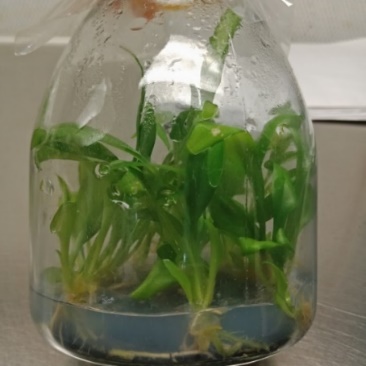
Kaempferia galanga shoots after supplementation with 0.2 mg/L NAA

Kaempferia galanga shoots ready for transplantation

In vitro Kaempferia galanga plants grown in a nursery after 5 weeks
REFERENCES
-
Chithra M., Martin K.P., Sunandakumari C., & Madhusoodanan P.V. (2005). Protocol for rapid propagation and overcoming delayed rhizome formation in field-established in vitro-derived plantlets of Kaempferia galanga L. Scientia Horticulturae, 104(1), 113-120.
-
Đỗ Huy Bích et al. (2004). Medicinal Plants and Animals in Vietnam (Vol. 1). Hanoi: Science and Technology Publishing House, pp. 782-785.
-
Đinh Trường Sơn et al. (2021). Effects of growth regulators on in vitro propagation of Kaempferia galanga L. Vietnam Journal of Agricultural Science, 19(8), 1084-1090.
-
Kumar A. (2020). Phytochemistry, pharmacological activities, and uses of traditional medicinal plant Kaempferia galanga L. – An overview. Journal of Ethnopharmacology, 253, 112667.
-
Parida R., Mohanty S., Kuanar D., & Nayak S. (2010). Rapid multiplication and in vitro production of leaf biomass in Kaempferia galanga through tissue culture. Electronic Journal of Biotechnology, 13.
-
Shetu H. et al. (2018). Pharmacological importance of Kaempferia galanga (Zingiberaceae): A mini review. International Journal of Pharmacy and Pharmaceutical Sciences, 3, 32-39.
-
Shirin F., Kumar S., & Mishra Y. (2000). In vitro plantlet production system for Kaempferia galanga, a rare Indian medicinal herb. Plant Cell, Tissue and Organ Culture, 63(3), 193-197.
-
Yao F. et al. (2018). Anti-inflammatory diarylheptanoids and phenolics from the rhizomes of kencur (Kaempferia galanga L.). Industrial Crops and Products, 125, 454-461.