1. Variety Description 
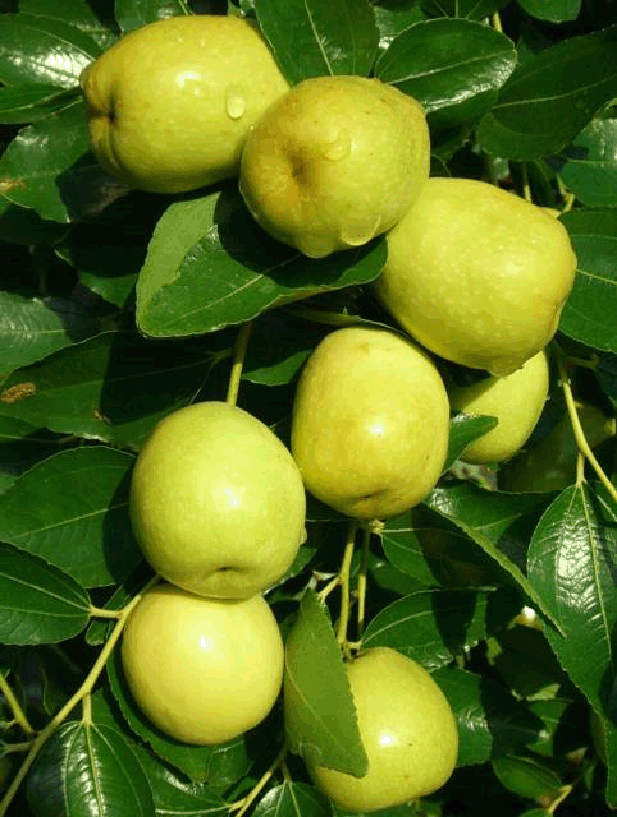
Name: Golden Peach Apple belongs to the Rhamnaceae family. The apple trees sold at the center are grafted, so they begin to bear fruit within 12–18 months after planting.
Usage Value: Golden Peach Apple is a variety with large, sweet, crispy fruits, beautiful color, and low susceptibility to pests. It is particularly well-suited to hilly garden soils, drought-resistant, and highly productive under intensive farming, bringing high economic efficiency.
Morphological Characteristics:
The tree grows upright or spreads out with drooping branches. The branches are twisted and dense. Leaves are alternate, oval or elongated elliptical, 2–4 cm long, dark green, glossy on the upper surface, with three distinct longitudinal veins and clearly serrated edges. Flowers are small, have five petals, light yellow, and grow in clusters of 2–3 in the leaf axils.
Ecological Characteristics:
This tree is easy to grow and adapts well to various soil types. It has high and stable productivity and is not prone to serious pests. If pruned early, it will bear fruit sooner the following year.
2. Planting and Care Techniques
Planting Time and Density
The main planting season is from February to April. If the grafted seedlings are prepared early, they can be planted from November. In spring, with favorable weather conditions, the tree grows quickly and will bear many fruits by the end of the year. The usual planting distance is 3–4 meters per tree.
Planting Method and Density
-
Dig planting holes of 40x40x40 cm.
-
Apply 15–20 kg of decomposed manure + 0.5 kg of superphosphate + 0.3 kg of lime powder per hole.
-
Mix all fertilizers thoroughly with soil and place them in the hole, forming a mound 20 cm above ground level (do not plant trees directly in the fertilizer).
-
If manure is unavailable, 5–7 kg of bio-phosphate fertilizer can be used per hole.
Care and Fertilization
-
In the first week, water the plant once daily in the morning or afternoon, ensuring the soil is thoroughly moistened.
-
After the first week, water every 2–3 days for the first month. As the tree grows, watering can be reduced but must keep the soil moist.
-
Every year, fertilize after harvest and pruning to restore tree strength for the next season. Recommended fertilizer per tree:
-
Organic manure: 30–50 kg
-
Superphosphate: 5–8 kg
-
Potassium chloride: 3–5 kg
-
Urea fertilizer: 0.5–1 kg
-
Pruning Techniques
Golden Peach Apple trees bear fruit on new spring shoots, so pruning should encourage strong branch growth for high productivity. There are two pruning methods:
-
Light Pruning: Done annually after harvest to maintain stable and high yields.
-
Heavy Pruning: Applied to young trees (1–3 years old) or older trees that need canopy restructuring. All branches are cut, leaving only three strong main branches from the previous year. This helps the tree regenerate and increase fruit yield.
3. Pest and Disease Control
Common Diseases
-
Root Rot and Trunk Cracking: Common in wet soils where fungi attack the taproot and destroy the root system, causing the tree to wither and die. Symptoms include sparse foliage, pale green leaves that fall off, and branches dying from the tip downward. Prevention includes avoiding excessive moisture around roots and early detection of longitudinal cracks and blackened wood tissue.
-
Branch Dieback: Caused by the fungus Colletotrichum cloeosporiodes, leading to branch death. On mature fruits, the fungus enters through wounds, causing rotting. The disease worsens with prolonged direct sunlight exposure.
-
Fruit Disease: Fungal infections during fruit development cause small black spots and cross-like scars, reducing fruit quality and market value. Preventive measures include keeping the orchard well-ventilated, removing diseased debris, and spraying fungicides after fruit setting.
Common Pests
-
Root-Damaging Insects: Includes termites, grubs, crickets, ants, and mealybugs, typically found in the 0–50 cm soil layer. Infected trees show yellowing leaves, weakened growth, and may die easily.
-
Stink Bugs: These insects suck sap from young shoots and leaves, causing wilting, deformity, and fruit drop. This also opens pathways for fungal infections, significantly reducing yield and fruit quality.
-
Branch-Boring Weevils: Common from mid-rainy season to early dry season, these insects bore small holes in stems and branches, reducing growth and making branches brittle.
Control Methods
-
For sap-sucking insects: Use Sherpa (0.1%), Trebon (0.1–0.2%), Depterx (0.2%), Dantinol (0.1–0.2%), Monitor (0.1–0.2%), Bi58, or Báudin.
-
For leaf-eating insects: Use Azodrin 50DD (0.2%), Score (0.05%), Aliette (0.3%), or Mancozeb (0.25%).
-
For root-damaging pests (termites, ants, beetles): Use Báudin, Lidanfor, or Sevidol. Mix pesticide with sand in a 1:10 ratio and sprinkle around the base of the tree and planting hole.
4. Harvesting
Apples are harvested 2–3 months after flowering, when the fruit is large, firm, and has a bright color. Harvesting is done manually, taking care to avoid bruising the fruit during transportation.