RED DRUG DRAGON GROWING TECHNIQUES
(Hylocereus undatus (Haw) Britt & Rose)
1. Breed description
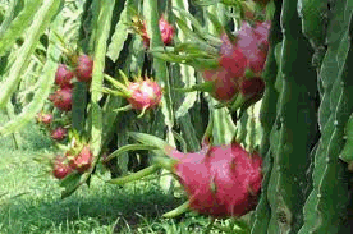
* Name: Dragon fruit belongs to the Cactus family (Cataceae), originating in Central and South American countries, imported into Southeast Asian countries for ornamental purposes, food and medicine. The red-flesh dragon fruit tree produces its main fruit crop in the summer or fall, but now people can grow dragon fruit for fruit all year round.
* Morphological characteristics: Dragon fruit is a climbing plant up to 10m long, clinging to the substrate thanks to secondary roots. The body is green, has 3 flat sides with ruffled ears, often horny at the edges, and has few and short spines.
* Ecological characteristics: Dragon fruit belongs to the group of plants that love light, has roots and eats shallow, so the land for growing dragon fruit must be airy and not flooded during the rainy and flood seasons. Trees must not be shaded from sunlight for more than 30% of the illuminated area; Irrigation water is not contaminated with alum or salinity.
2. Planting and care techniques
* Planting season
Can be planted any time of the year. It is recommended to plant at the beginning of the rainy season (March-April of the solar calendar) to reduce irrigation costs and when the dry season comes, the tree will be large enough to withstand high temperatures and drought.
* Planting method and density
– Planting density: 1100 posts/ha.
– Planting distance: 3m x 3m
* Prepare the soil
– You should build a mound to help with good drainage.
– Tissue size: Height 10-15cm, diameter 60-0.80cm.
The tissue used to grow dragon fruit is topsoil mixed with 15-20 kg of manure. The soil is prepared 1-2 weeks before planting dragon fruit. Use Benomyl (0.1% concentration) to water the soil before planting to prevent fungal diseases.
* Prepare the pillar
– Cement pillar: 2.0 long, 12-15cm square edge.
– The pillar is buried 0.5-0.6m deep and made into a mound.
* Select seedlings
– Cuttings are 30-40cm long, choose branches that are big, strong, straight, free from pests and diseases, and branches age > 6 months.
– The bottom of the cuttings (3-5cm long) is cut off the outer flesh, leaving the core, to avoid rotting of the cuttings, then dipped in a fungicide solution such as Benlate C, 0.1% concentration for 5 minutes. .
– Cuttings can be planted before planting in a shaded area until the branches take root and sprout new shoots, or they can be planted directly in the field.
* How to plant: Place the core on the ground, the flat side of the dragon fruit body hugs the post and use nylon string to tie the branch to the post, place 4 cuttings on each post.
* Watering: After planting, the cuttings must be watered regularly twice a day (do not water too much as it will cause root rot). When the tree has grown and developed, water the tree depending on the weather, do not let it exceed dry and do not over-water, pay attention to drainage when it rains and floods
* Fertilize
– When the tree is young (under 3 months) 2 weeks after planting (for trees with complete roots), you can use Urea + DAP or NPK 16-16-8 or 20-20-15 for watering, dose of 20 -30g/head, 10 days/time
– Organic fertilizer: You can use decomposed or organic manure 20-50kg/head/year (the amount of fertilizer increases with tree age and depending on the soil), divided into 2 fertilizer applications. The first time is when the tree is about to bloom (February – March 3rd), the second time is September – December 10th, after the period of full fruit production, the stage of producing new branches and preparing to grow fruit in the off-season. How to fertilize: lightly rake around the base, 15-30cm from the base, apply fertilizer evenly throughout the canopy and use straw and grass to cover the base.
– Chemical fertilizer: You can use NPK 20-20-15 or Urea, DAP, KCl monomers, depending on the purpose. When used for flowering and fruit growing, pay attention to high phosphorus and potassium content, stimulating growth. Like plants that produce new branches, they need high nitrogen fertilization.
* Prune branches and create canopy
From the ground to the top of the pillar, choose to leave only 1 branch. During this time, you need to pay attention to tying the branch close to the pillar so that the aerial roots of the branch cling tightly to the pillar to help the branch not break when exposed to rain, wind, etc.
At the top of the pillar, branches can be pruned to create a rounded canopy and evenly distributed around the pillar. New branches on the top of the pillar will be pruned according to the principle: one mother branch, 2 daughter branches. Choose large, strong branches to leave behind. Regularly prune away mouse-eared branches, diseased branches, branches hidden in the canopy, and branches that have produced fruit for 2-3 years.
3. Prevention of pests and diseases
* Harmful insects
– Ants: Dragon fruit is easily attacked by fire ants and spider ants, which can be easily prevented and treated with insecticides. Spray (spread) around the base of the tree and right at the site of ant attack, or as an attractant residue
– Fruit flies: You can use bait (SOFRI protein) or cover the fruit 7-10 days after pollination
* Harmful diseases
+ Branch rot and branch melasma can be easily prevented and treated with copper-based drugs such as Benlat C, Coc 85, Ridomyl,…
+Anthracnose: appears on branches and fruits.
Prevention and treatment: Spray with Ridomyl, Antracol, etc. For fruits: 3-5 days after blooming, flowers need to be trimmed with wilted pistils at the top of the fruit, sprayed and covered with non-woven fabric.
4. Harvest
Depending on the market, the fruit can be harvested from 29 to 31 days after the flowers bloom. When harvesting, use scissors to cut and move carefully, avoiding crushing and damaging the fruit.